Families who place a loved one in a nursing home do so trusting that they will receive proper, dignified care. Sadly, that trust is too often broken. Nursing homes operating as for-profit businesses are frequently understaffed, under-resourced, and motivated by filling beds rather than providing the level of care each resident actually needs. When that gap leads to injury or death, families have legal rights — and we are here to help them exercise those rights.
Types of cases we handle
Nursing home residents often have physical conditions, dementia, or poor safety judgment that make falls predictable — and preventable. Facilities are required to assess fall risk and maintain active care plans to address it. When they fail, the consequences are severe. Residents with osteoporosis face hip fractures that frequently prove fatal. Those on blood thinners are at heightened risk for brain bleeds after even a minor fall. One fall commonly leads to another, making falls among the leading causes of decline and death in this population.
Bed sores are almost always the result of neglect. The three primary causes — immobility, incontinence, and poor nutrition — are all manageable with proper staffing and attentive care. When nursing homes fail to prevent or treat them, residents can develop serious infections including cellulitis and osteomyelitis. Bed sores on the heels or ankles can ultimately require amputation. Where they contribute to a resident’s death, they can form the basis of a wrongful death lawsuit.
Many nursing home residents take multiple medications, and managing that complexity across an entire facility creates serious risks — medications given to the wrong resident, wrong dosages, missed doses, or drugs administered after an order to stop. Trained nurses are supposed to catch these errors before they reach a resident, but when the systems designed to prevent mistakes break down, the results can be catastrophic.
Residents with Alzheimer’s, Parkinson’s disease, or a history of stroke are at elevated risk of choking and require modified diets and supervised mealtimes. Too often, nursing homes fail to address choking risk with the same rigor applied to other safety threats. Many choking incidents end in wrongful death. Early investigation is critical, because speech therapists — typically outside contractors, not direct employees — are often key witnesses in building the case.
Physical and sexual aggression between residents occurs with frightening regularity. Nursing homes often house residents with a mix of physical and psychiatric conditions, and those with behavioral issues frequently have documented histories of aggression. Nursing homes have a legal obligation to keep residents safe — including declining to retain residents whose behavior they cannot safely manage. When they fail to act on clear warning signs, they can be held accountable.
“Elopement” refers to a resident leaving the facility without supervision. Residents at risk are typically mobile but impaired by dementia, mental illness, or poor safety judgment. When elopement occurs, the dangers are serious: falls, traffic accidents, exposure, criminal assault, and more. Nursing homes are required to assess elopement risk upon admission and take concrete measures — secure units, wanderguard bracelets, increased supervision — to prevent it.
Nursing homes permit residents to smoke, and like every other risk to resident safety, that activity must be properly supervised. Residents with dementia or movement disorders may mishandle cigarettes or lighters, causing burns to skin or clothing. Smoking near compressed oxygen equipment or other flammables creates a risk of flash fires. When these incidents occur, inadequate supervision by nursing home staff is almost always a contributing factor.
Why nursing home failures happen: the business model
Most nursing homes are for-profit enterprises that maximize revenue by filling as many beds as possible — ideally with the highest-acuity residents, who command higher reimbursement rates — while minimizing expenses. Staffing is one of the largest costs a nursing home carries, which means that decisions made in a boardroom about labor budgets directly affect how much time and attention each resident receives. This dynamic holds in not-for-profit facilities as well. The entire industry is shaped by incentives that frequently conflict with the quality of care residents deserve.
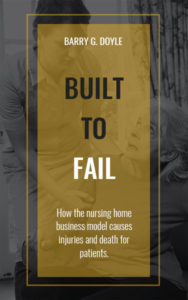
We have written a free report on this subject: Built to Fail — a free nursing home report, available for download at no cost.
How we investigate nursing home cases: the care planning framework
When a resident is admitted to a nursing home, a formal care planning process begins. This process is supposed to govern how every aspect of a resident’s care is delivered — and it is the framework we use to investigate and build our cases. Events that appear to happen in an instant, like a fall, often have their roots in failures that began weeks or months earlier. The care planning process exposes all of them.
The six stages of the care planning process
Assessment
Upon admission, the resident undergoes a comprehensive evaluation to identify risks to their health, safety, and well-being.
Care plan
Based on the assessment, a written care plan is created that assigns specific interventions to staff members, to be carried out on a day-to-day, shift-to-shift basis.
Communication
The care plan must be communicated clearly to every staff member responsible for carrying it out.
Implementation
The interventions in the care plan must actually be performed — consistently, across every shift.
Evaluation
The effectiveness of the care plan must be assessed on an ongoing basis to ensure it is working and reflects any changes in the resident’s condition.
Revision
When the care plan is not working, or when a resident’s condition changes, the plan must be updated to meet the resident’s actual needs.
Holding nursing homes accountable
Many of the nursing home cases we handle become wrongful death cases, because residents do not survive what was done — or not done — to them. Families in grief often wonder whether pursuing a case is worth it. Our answer is always yes, for two reasons.
First, we have a track record of securing significant settlements on behalf of the families we represent. Second, the investigation and litigation process creates real accountability. We have seen nursing homes change policies and retrain staff as a direct result of our cases. When families hold a facility responsible, they help protect other families from experiencing the same loss.
You can also file a complaint about a nursing home directly with the Illinois Department of Public Health.
Get a free consultation — no fee unless we recover for you
Our attorneys and legal nurse consultants investigate the full chain of events behind every nursing home injury. We will make you aware of your rights from the very first conversation, at no cost to you.